Scientific materialism in all its glory
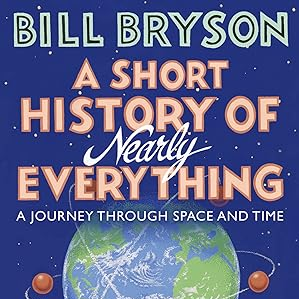
A Short History of Nearly Everything by Bill Bryson
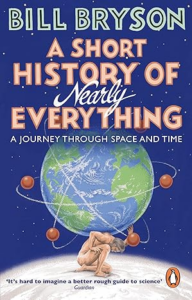

It takes some courage to pick up this tome. It’s BIG. If you take the plunge, you’ll discover it’s very well researched, very readable, and very informative. The cosmology and physics are presented simply and clearly. The historical developments in such areas as geology, paleontology, archaeology, evolution and genetics are all meticulously documented, honouring all the discoverers by name and revealing their often bizarre motivations, strengths and weaknesses.
Here are some quotes to show the tone of Bryson’s writing:
When the Earth was only about a third of its eventual size, it was probably already beginning to form an atmosphere, mostly of carbon dioxide, nitrogen, methane and sulphur. Hardly the sort of stuff that we would associate with life, and yet from this noxious stew life formed. Carbon dioxide is a powerful greenhouse gas. This was a good thing, because the Sun was significantly dimmer back then. Had we not had the benefit of a greenhouse effect, the Earth might well have frozen over permanently, and life might never have got a toehold. But somehow life did.
For the next 500 million years the young Earth continued to be pelted relentlessly by comets, meteorites and other galactic debris, which brought water to fill the oceans and the components necessary for the successful formation of life. It was a singularly hostile environment, and yet some-how life got going. Some tiny bag of chemicals twitched and became animate. We were on our way.
Four billion years later, people began to wonder how it had all happened. [P. 63]
Darwin and his geological friends needed the Earth to be old, but no-one could come up with a way to make it so. [P. 105]
Yet when you consider conditions elsewhere in the known universe, the wonder is not that we use so little of our planet but that we have managed to find a planet of which we can use even a bit. You have only to look at our own solar system – or, come to that, the Earth at certain periods in its own history – to appreciate that most places are much harsher and much less amenable to life than our mild, blue, watery globe. [P.303]
Lonely Planet
Chapter 16 states that ‘if you wish to have a planet suitable for life, you have to be awfully lucky.’ Bryson then lists four of the fortunate breaks that Earth enjoys [P. 304-308]:
- An excellent location, just the right distance from our life-enabling star, the Sun
- The right kind of planet, in terms of composition, topography and atmosphere
- A twin planet, the Moon, whose gravitational influence keeps us stable
- Impeccable timing, in terms of ice ages and the like, which favoured our evolution.
He does, however, add a rider: ‘a big part of the reason that Earth seems so miraculously accommodating is that we evolved to suit its conditions.’
The rise of life
Organic compounds can arise spontaneously from a mixture of primeval gases and water through the actuation of an artificial lightning strike. What about proteins? ‘By all the laws of probability, proteins shouldn’t exist… Proteins can’t exist without DNA and DNA has no purpose without proteins. Are we to assume, then, that they arose simultaneously with the purpose of supporting each other?’
‘We are no nearer to synthesizing life today than we were in 1953.’ [P. 350, 352]
Whatever prompted life to begin, it happened just once. That is the most extraordinary fact in biology, perhaps the most extraordinary fact we know. Everything that has ever lived, plant or animal, dates its beginnings from the same primordial twitch. At some point in an unimaginably distant past some little bag of chemicals fidgeted to life. It absorbed some nutrients, gently pulsed, had a brief existence. This much may have happened before, perhaps many times. But this ancestral packet did something additional and extra-ordinary: it cleaved itself and produced an heir. A tiny bundle of genetic material passed from one living entity to another, and has never stopped moving since. It was the moment of creation for us all. Biologists sometimes call it the Big Birth. [P. 357-358]
Darwin’s singular notion
Charles Darwin, having failed as a student of medicine, law and divinity, had the privilege of sailing on the naval survey ship HMS Beagle, essentially as dinner company for the captain. From 1831 to 1836, he experienced adventure enough to last a lifetime. En route, he accumulated a hoard of specimens sufficient to make his reputation and to keep him occupied for years. In late November 1859, he published On the Origin of Species by Means of Natural Selection, or the Preservation of Favoured Races in the Struggle for Life. It was priced at 15 shillings and has never been out of print.
The notion of creation by design was a powerful one in the nineteenth century, and it gave Darwin trouble. ‘The eye to this day gives me a cold shudder,’ he acknowledged in a letter to a friend. In the Origin he conceded that it ‘seems, I freely confess, absurd in the highest possible degree’ that natural selection could produce such an instrument in gradual steps.
Ironically, considering that Darwin called his book On the Origin of Species, the one thing he couldn’t explain was how species originated. Darwin’s theory suggested a mechanism for how a species might become stronger or better or faster – in a word, fitter – but gave no indication of how it might throw up a new species.
Darwin’s theory was a recipe not for change, but for constancy. [P.473]
Darwin did eventually make his belief in our kinship with the apes explicit in The Descent of Man in 1871. The conclusion was a bold one, since nothing in the fossil record supported such a notion. [P. 477]
Bryson goes on to relate the history of discovering The Stuff of Life (DNA etc.), before staring on the last section: The Road to Us.
The restless ape
Paleontologists have discovered rather few partial skeletons of apparent hominids in some very unlikely places. They have attempted to piece them together into some sort of progression from simple apes to deliberate, tool-making beasts.
Something over a hundred thousand years ago, a smarter, lither species of creature – the ancestors of every one of us alive today – arose on the African plains and began radiating outwards in a second wave. Wherever they went, according to this theory, these new Homo sapiens displaced their duller, less adept predecessors.
We know less about ourselves, curiously enough, than about almost any other line of hominids.
Tongue in cheek, Bryson reflects on our unlikely position as Senior Manager of this Universe:
I mention all this to make the point that if you were designing an organism to look after life in our lonely cosmos, to monitor where it is going and keep a record of where it has been, you wouldn’t choose human beings for the job.
But here’s an extremely salient point: we have been chosen, by fate or providence or whatever you wish to call it.
Conclusion
As the title suggests, this book is about the history of things – cosmic and microscopic, material and living. It also tells the stories of the principle players (Homo sapiens) who discovered or investigated those things. As might be expected, therefore, it seldom delves into the thoughts and ruminations of those players. Occasionally, a question is raised or a puzzling statement made, which might trigger philosophical reflection. But the reader is left to answer it him or herself.
If this book has a lesson, it is that we are awfully lucky to be here – and by ‘we’ I mean every living thing. To attain any kind of life at all in this universe of ours appears to be quite an achievement.
A Short History of Nearly Everything is not short. But it is very readable, informative and thought-provoking. Nevertheless, much of it is extremely speculative and it leaves many issues unanswered. It paints a picture of a universe – including the Earth and us Earthlings – as purely fortuitous, without cause and without purpose. See Stand up for science! and Why I can’t believe in No God.