God blesses all peoples
The Bible and Other Faiths by Ida Glaser

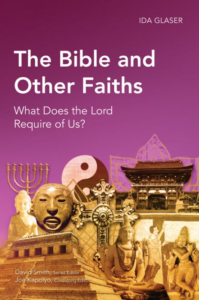
Ida Glaser expounds on her in-depth knowledge of the Christian Bible. This she combines with her extensive experience interacting with people of different faiths in various parts of the world. She has chaired workshops bringing Christians and Muslims together. The result is a thought-provoking treatise emphasising God’s supreme love and concern for all of His Creation – especially us human beings. It also explores the religious aspirations and beliefs of many cultures outside the biblical Judeo-Christian heritage.
Abstract
As the subtitle, ‘What does the Lord require of us?’ (Micah 6:8) suggests, the author’s motivation is to seek God’s will. In particular: how should we relate to people who adhere to other faiths than that revealed in the Christian Bible.
Glaser’s conclusion is that the insights and practices of other religions are generally honest attempts to approach God. They piece together as best they can the signs and implications of the universally acknowledged spiritual realm. Then they establish appropriate forms of relating to that poorly known deity. The author warns against arrogance. Does our conviction about what we believe mean we despise those who practise a different religion?
God’s supreme revelation to mankind is the person of Jesus, who appeared in human form 2000 years ago, died and rose again. His message is love for all people. As such, we are called to worship Him as best we know how. And we are not to judge or condemn others, whose faith is perhaps less well founded on God’s revelation, but love them.
Appraisal
Frequent questions at the end of sections stimulate the reader to reflect on what has just been said and possibly to apply the lessons in practice. As such the book opens one’s eyes to new ways of considering both biblical texts and relating to adherents of other religions.
However, the arguments are somewhat tedious to follow and tend to be repetitive. The author’s premise, which I might sum up with the following quote, could have been developed more pointedly:
We can summarize this section, and perhaps the whole of this chapter [8 God, Gods and Nations], by saying that God treats all peoples as human beings. He made them, so he is their Lord, whether they acknowledge him or not. They are made in his image, so they are able to hear and respond to him, and there are good things in their writings. But they are also fallen, so there are wrong things in their beliefs as well as their actions. They deserve judgment, but God wants to bless them. And so, through his chosen people Israel, he does bless them. [P. 110]
Further quotes
If we look at the overall shape of the Bible, we have to conclude that, whatever Israel was chosen for, God’s purposes have always been for the whole of humanity and not only for one particular nation. [P.30]
Similarly, when we move to the New Testament, the church does not exist for its own sake but for the sake of the nations. [P. 31]
The first thing the Bible teaches us about people of other faiths is that they are human beings, in God’s land and under God’s rainbow, just like us. [P. 43]
Although the end of Genesis 11 introduces Abraham, the people of Israel are until then only incidentally included in the creation story. The society that is the result of the creation process is not a particular people in a particular land, but all peoples, in all lands. [P. 48]
Isaac, Jacob and Jacob’s sons all had to learn the same lessons. The God of their father was also their God. Unlike El and the other gods, he had not given a set of laws to keep. He had not given any rituals for worship. He had not even said what was ‘clean’ and ‘unclean’. He had called them as individuals and as a family. He would keep his covenant and fulfil his purpose through them, no matter how long it took them to learn their lessons of faith and obedience. [P. 57]
It seems that the presence of one of God’s people brings with it the presence of God, and therefore his blessing. [P. 59]
Forms of worship are not yet important. Worship is expected as a response to God, but, within certain boundaries, it is acceptable in the familiar form of the culture to which the patriarchs belong. [P. 61]
In calling out a people from polytheism, then, God did not give a religion. The way to blessing for a multi-faith world was not a religion, but a family called to dynamic relationship with the living God. [P. 62]
Israel had to go through a long process to learn who Yahweh was and what was involved in being his special people. It was hard for her to understand that Yahweh’s choice of her did not mean that she was his favourite. Rather, she was chosen by the one God of all peoples for the sake of all peoples. She was one of many similar nations created by God, and so shared the human characteristics of all nations; but she was also different. [P. 63]
Daniel answers a resounding ‘Yes’ to the question of whether God’s people can live and worship without power, temple or land, at the very heart of a nation with a faith very different from that of Israel. [P. 92]
Yet, in the context of the story of God’s salvation, there is room for some of the wisdom of the nations. [P. 101]
There is hardly any suggestion that the nations are punished because they worship these gods. [P. 105]
‘Blessed be Egypt my people, Assyria my handiwork, and Israel my inheritance’ (Isaiah 19:25). Yahweh claims Egypt and Assyria as well as Israel, and blesses them. [P. 107]
It seems that all religious practices are liable to have the same result: to enslave us to religion, when we should be free in Christ. [P. 127]
It is when a religion becomes associated with economic interests, a totalitarian state or a powerful political leader, that it becomes ‘beastly’ – less than human. [P. 134]
The basic question is, ‘How can we both relate to our neighbours of other faiths and remain loyal to Christ?’ [P. 148]
The Old Testament tells of judgment of the Gentile peoples because of their crimes and barbarities and their treatment of Israel, but not because of their religion. [P. 163]
God’s kingdom is not the same thing as a Jewish state. Jesus was simply not interested in restoring a political kingdom to Israel. And, what is even more significant, the land of Israel does not seem to matter to the New Testament writers. [P. 165]